

The SaaS software market is projected to reach a 13.53% CAGR, or be worth USD 412.14 billion, by 2034 [1]. According to Gartner, worldwide end-user SaaS spending is forecasted to reach USD 300 billion in 2025 [2]. The use of SaaS solutions spans across a variety of sectors, from banking and financial services to retail, healthcare, education, hospitality, manufacturing, and many more.
However, many still believe outdated myths about this technology. They think it is too pricey, hard to use, or not secure enough for their data.The reality tells a different story. The widespread cloud adoption during and post-COVID proved that these solutions are not only agile in solution types but also in cost plans.
First, let’s get into what businesses typically perceive as wrong about SaaS.
Read more:Tech Tidbits: What is Software-as-a-Service (SaaS)?
Why myths about SaaS still exist
Several factors keep SaaS myths alive today, many of which started during the early days of cloud computing, when the solution was still in its “infant stage” and certainly could not match its on-premises opponents in both performance and functionality. Unfortunately, most of the misconceptions linger on until today, even though the technology has come a long way since then.
Moreover, information overload and fear of change also help these myths stay alive. Nowadays, businesses are constantly bombarded with information about the latest advanced technologies, making it difficult to separate fact from fiction. Additionally, learning and adapting to new technologies is a long-winded process that can easily be upended if businesses face poorly implemented or inadequate software. IT project failure is not uncommon, but it can create fear lurking across the company and create a lasting sense of hesitation.
Read more: Fundamentals of Cloud | Public v Private, SaaS v Hosted, Multitenancy
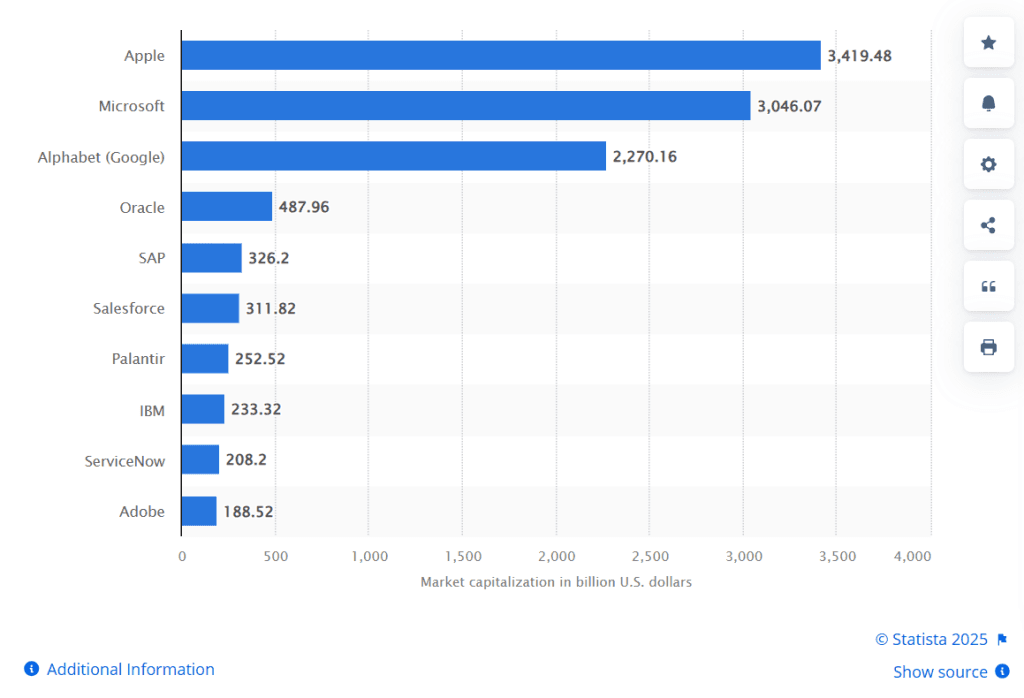
Leading SaaS companies worldwide (by market capitalisation in USD) as of May 2025, according to Statista [3]
Myth 1: SaaS is not secure or reliable
Many organisations still believe that on-premises solutions provide better protection, and thus, security and reliability fears top the list of barriers to SaaS adoption.
The reality is: This is a valid concern, as moving, storing, and managing data in the cloud comes with a whole set of challenges. For instance, according to a 2023 survey done by Statista, 43 per cent of respondents expressed concerns about identity and access governance [4]. As SaaS becomes more and more mature and regulatory pressure rises, its security also becomes the top priority.
SaaS vendors take a comprehensive approach to data protection and cybersecurity. They encrypt information both at rest and in transit through industry-approved protocols with secure settings.
Together with stricter regulations, such as GDPR, software providers must now employ and enforce proper protection measures to:
– Automatically detect threats
– Watch for malicious content, suspicious activities, and possible security breaches
– Identify potential using analytics and machine learning
– Establish proper protocols to contain breaches, evaluate their impacts, notify affected parties, and reverse the situation
Most businesses cannot match what leading providers offer:
– Distributed storage systems with redundancy and replication
– Automatic failover mechanisms to prevent service disruptions
– Geographic distribution of data centres to reduce regional outages
– Continuous monitoring and proactive issue resolution
Read more:How Data is Protected in Infor CloudSuite with These 5 Security Layers
Nevertheless, businesses should also take a proactive role in preventing breaches from happening by:
– Regularly train staff to raise their awareness of the importance of data protection
– Develop detailed disaster recovery plans
– Clearly define levels of employee access and hierarchy
Data protection is not just about keeping systems running. SaaS providers use robust backup systems that save information automatically and immediately. This built-in redundancy removes the need for separate backup systems that on-premises solutions usually need.
Read more:How to Protect Your Data When Employees Leave
Moreover, the SaaS model makes security updates faster. Unlike traditional software with quarterly updates, SaaS platforms can fix security issues as soon as teams find vulnerabilities, keeping systems safe from new threats without extra work.
Myth 2: SaaS lacks customisation and control
Are you still afraid that SaaS solutions are rigid, unintuitive, and will cause trouble when your business scales?
The reality is: Customer experience sits at the heart of effective SaaS software. This commitment shows through easy-to-use interfaces, streamlined processes, responsive designs, and a library of connectors and APIs to assist businesses in software integration.
As businesses grow, their software needs also grow with them. Off-the-shelf SaaS solutions, while robust, may not have the capabilities needed to address specific needs. This is where customisation comes in to tweak the system and make it work how you want.
Read more:Single ERP suite vs. multiple best-of-breed systems
Personalisation can come in many shapes:
– Configuration: Typically involves adjusting user interfaces, workflows, reports, or basic functionalities.
– Integration: Through APIs or pre-built connectors to connect different applications (e.g., Sales and Marketing automation tools, accounting and analytics platform, etc.)
– Custom development: Typically involves adding new features, modifying existing ones, and designing an entirely new application for the SaaS platform. This is the most complex type of software customisation.
However, beware of over-customisation wreaking havoc on processes. Over-customisation can quickly become a poor patchwork by adding an array of new features (and certainly issues) that will confuse your end users and slow down future development efforts.
Myth 3: SaaS is too expensive in the long run
Businesses are often reluctant when evaluating SaaS recurring subscription costs, assuming they will pay more in the long run compared to traditional software.
The reality is: This assumption misses the complete financial picture.
SaaS and on-premises software have fundamentally different financial models. On-premises solutions need constant investments beyond licensing costs. These include maintenance contracts, hardware upgrades, and dedicated IT staff
On the other hand, SaaS pricing models offer a more predictable payment option. Teams can adjust their subscriptions based on actual usage, for instance, due to changes during seasonal demands. This prevents the common issue of buying more than needed in traditional infrastructure.
Another key factor that allows SaaS software to be more cost-effective is shared computing resources. In essence, SaaS providers “share” their infrastructure with your business along with numerous other customers. This allows them to achieve economies of scale while optimising resource allocation (computing power, storage, and other resources customers demand). Many SaaS solutions are powered by multi-tenant architecture, where multiple customers share the same underlying infrastructure but maintain separate databases, thus further reducing costs.
Read more: Why CFOs should be looking to the Cloud
SaaS solutions cut out the hardware and perpetual licensing costs tied to traditional software ownership. Another key advantage is that the provider handles all infrastructure maintenance, security measures, and compliance instead of the customer. This setup moves both risk and cost away from the business.
Have you ever wondered how much SaaS development costs? Endless investments are put into developing and enhancing this software to better serve the ever-increasing customer base. The graphic below from Auxano Global Services [5] gives us a glimpse into how each type of SaaS development costs. Depending on a combination of factors, such as the complexity of the product and the industry, the final prices may vary.
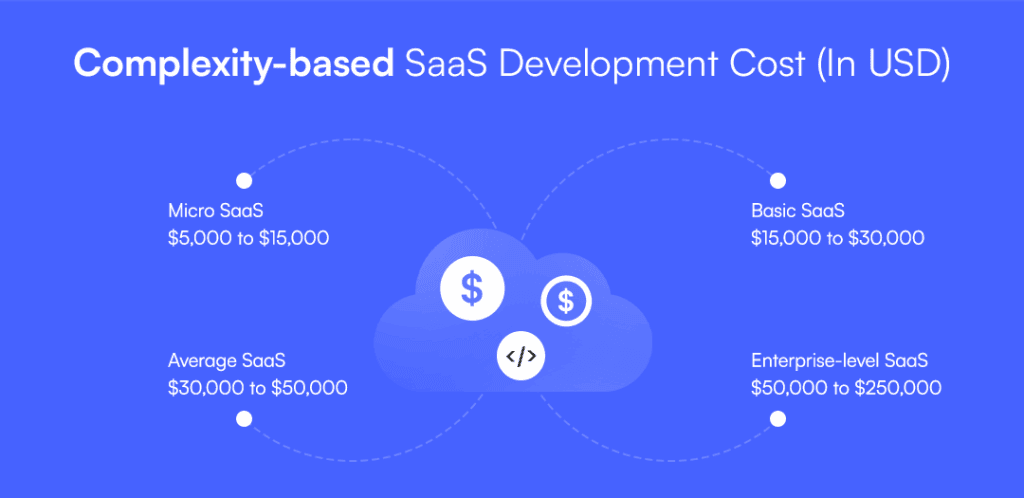
Image credit: Auxano Global Services [5]
Myth 4: SaaS is only for large enterprises
The reality is: Businesses of all sizes and industries can benefit from SaaS solutions.
With a stable growth in SaaS software spending, business adoption and reliance on these solutions will continue to rise. Spending per employee on SaaS products increased to USD 8,700 from USD 7,900 last year [6]. 45 per cent of small-to-medium businesses spent USD 600,000 annually on SaaS, and 16 per cent spent up to USD 2.4 million [7].
SaaS has changed the digital world by levelling the playing field, removing the barriers of using advanced technologies and not making it the sole privilege of enterprises with deep pockets.
Read more: 10 Factors to Consider When Choosing Your Cloud Deployment Option
Leveraging SaaS provides smaller businesses with several key advantages:
– Lower capital expenses: Eliminate the need for purchasing expensive hardware and software licences.
– Better access: Business data becomes available anywhere, which supports remote work and flexibility.
– Less IT work: SaaS vendors are responsible for the development, maintenance, and updates of their solutions.
– Better competition: Small businesses can use the same quality tools as bigger companies.
This shift to SaaS goes beyond just saving money; it enables businesses, regardless of budgets, to get hold of innovative solutions without hefty investment or specialised IT knowledge.
SaaS applications now power 70% of business applications, and this number should grow to 85% by 2025 [8]. This once again emphasises that this type of cloud model will become the key driver in many crucial business operations. New technological advancements will continue to reshape SaaS capabilities, for instance, incorporating AI and machine learning. These notions prove that SaaS has moved beyond trend status to become a foundational business technology.
All in all, the time for businesses to digitally transform is now. While scepticism about new technology is natural, we hope that the strong evidence shown in today’s article helps you gain a clearer picture of where SaaS stands today and its benefits to your business.
If you are interested in learning how to move to the cloud, check out our whitepaper below!

Source:
1. https://www.precedenceresearch.com/software-as-a-service-market
2. https://www.gartner.com/en/newsroom/press-releases/2024-05-20-gartner-forecasts-worldwide-public-cloud-end-user-spending-to-surpass-675-billion-in-2024
3. https://www.statista.com/statistics/1496279/top-10-saas-companies/
4. https://www.statista.com/statistics/1339520/adoption-saas-applications-security-concerns-worldwide/
5. https://auxanoglobalservices.com/saas-development-cost/
6. https://www.vertice.one/l/saas-inflation-index-report
7. https://www.statista.com/statistics/1472790/smb-saas-annual-spend-globally/
8. https://www.techtarget.com/searchcloudcomputing/definition/Software-as-a-Service